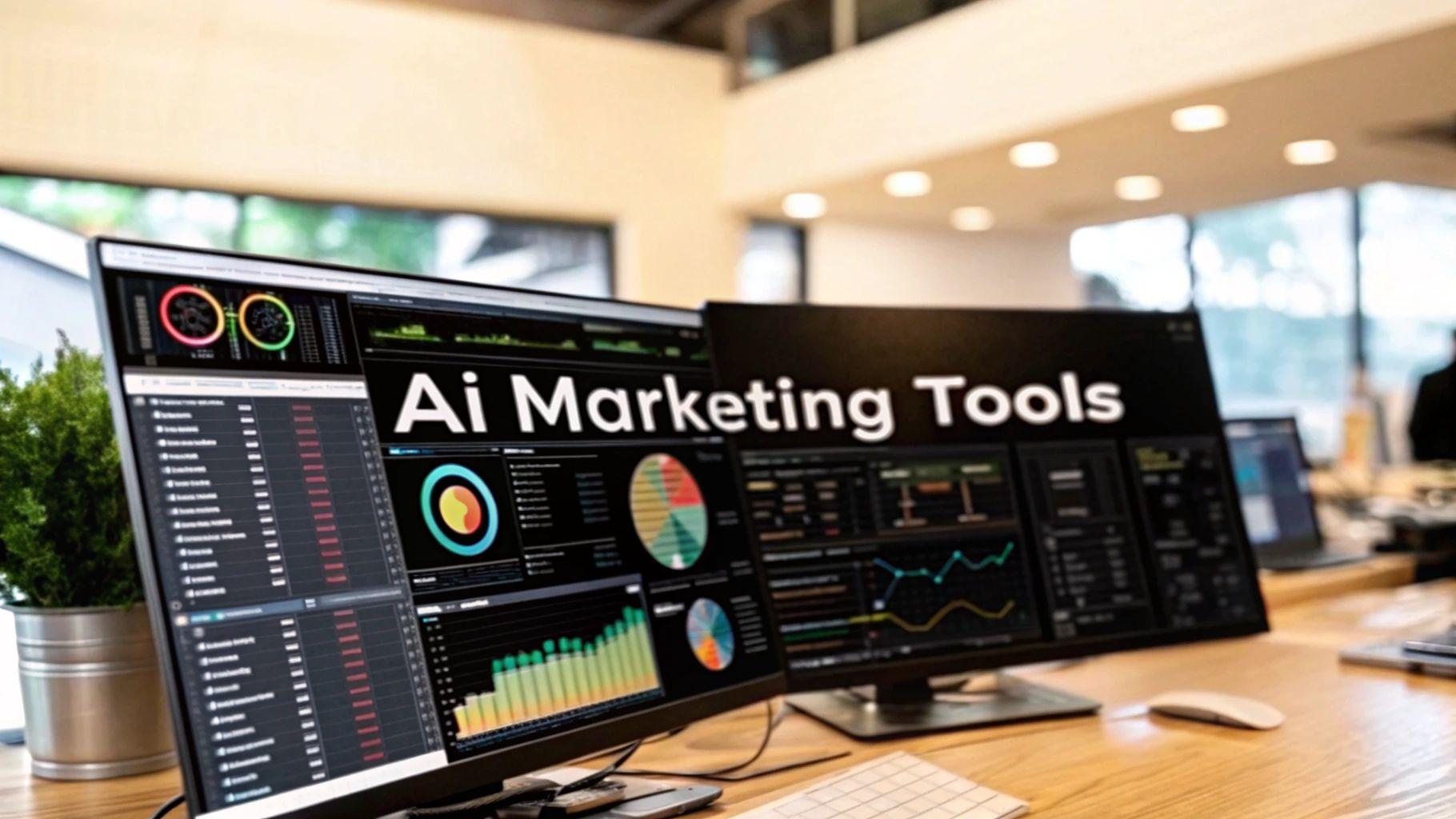
Artificial intelligence has completely changed the way marketers work.
What once took hours — content creation, campaign analysis, audience research, video editing, SEO optimization, ad testing, and customer support — can now be done in minutes with the right AI tools.
But in 2026, the challenge is no longer finding AI tools.
It’s finding the right ones.
Every week, new platforms claim to automate marketing, boost engagement, or replace entire teams. Some genuinely improve productivity and performance. Others are simply overhyped.
The best marketers today are not using AI to replace creativity.
They’re using it to:
- Work faster
- Scale smarter
- Analyze better
- Automate repetitive tasks
- Improve campaign performance
Here are the top 10 AI tools marketers should actually be using in 2026 — and why they matter.
1. OpenAI — ChatGPT
ChatGPT has become one of the most widely used AI tools in marketing.
In 2026, marketers use it for:
- Content ideation
- Blog writing
- Ad copy
- SEO outlines
- Email marketing
- Script generation
- Research
- Customer support workflows
- Strategy brainstorming
What makes it powerful is not just content generation — it’s versatility.
The best marketers use ChatGPT as:
- A research assistant
- A creative partner
- A workflow accelerator
Instead of replacing marketers, it helps eliminate repetitive work and speeds up execution dramatically.
Official Website: ChatGPT by OpenAI
2. Canva Magic Studio
Canva is no longer just a design tool.
Its AI-powered Magic Studio now helps marketers:
- Generate presentations
- Create social media graphics
- Remove backgrounds
- Generate images
- Resize content instantly
- Write captions
- Create branded content kits
For small businesses and marketing teams, Canva has become one of the fastest ways to create professional visual content without needing advanced design skills.
Why marketers love it:
- Fast workflow
- Team collaboration
- Brand consistency
- Beginner-friendly interface
Official Website: Canva Magic Studio
3. Google Gemini
Google Gemini is becoming increasingly important for marketers because of its deep integration with:
- Google Search
- Google Ads
- Workspace
- Analytics
- YouTube ecosystem
Marketers use Gemini for:
- SEO research
- Campaign planning
- Data summaries
- Content generation
- Search trend analysis
Its biggest advantage is access to Google’s massive data ecosystem.
For performance marketers, this makes Gemini especially valuable.
Official Website: Google Gemini
4. Adobe Firefly
Visual content is evolving rapidly, and Adobe Firefly has become one of the leading AI design tools for marketers.
It helps create:
- AI-generated graphics
- Social media creatives
- Text effects
- Product visuals
- Marketing assets
- Image expansions
Unlike many basic AI image generators, Firefly integrates directly with Adobe’s creative ecosystem.
This makes it extremely useful for professional creative teams.
Official Website: Adobe Firefly
5. HubSpot AI
HubSpot’s AI tools are now deeply integrated into CRM and marketing automation workflows.
Marketers use it for:
- Email automation
- AI-powered reporting
- Lead nurturing
- Smart segmentation
- Predictive analytics
- Customer journey optimization
One of its biggest strengths is combining AI with customer data.
This helps businesses create more personalized marketing experiences at scale.
Official Website: HubSpot AI
6. Notion AI
Notion AI has become extremely popular among marketers and content teams.
It helps with:
- Content planning
- Campaign organization
- Meeting summaries
- Brainstorming
- Workflow documentation
- Knowledge management
Marketing teams now use Notion AI as a centralized workspace for strategy, collaboration, and execution.
Why it matters:
Modern marketing is not just about content creation.
It’s also about managing information efficiently.
Official Website: Notion AI
7. Jasper
Jasper remains one of the strongest AI writing platforms focused specifically on marketing.
It’s commonly used for:
- Brand-focused copywriting
- Ad variations
- Sales copy
- Email campaigns
- Landing page content
- AI-assisted brand voice consistency
What separates Jasper from many general AI tools is its focus on marketing workflows and brand tone management.
Official Website: Jasper AI
8. Semrush AI Features
SEO in 2026 is changing rapidly because of AI-driven search experiences.
Semrush now includes AI-powered tools for:
- Keyword clustering
- Content optimization
- Competitor analysis
- Search intent analysis
- SERP tracking
- SEO recommendations
For marketers focused on organic growth, this has become one of the most useful AI-assisted SEO platforms.
Official Website: Semrush AI Tools
9. Runway
Video content continues to dominate social media, and Runway is one of the biggest AI tools transforming video production.
Marketers use it for:
- AI video editing
- Background removal
- Motion graphics
- AI-generated visuals
- Short-form content creation
- Fast video production
Why it matters:
Video creation used to require large teams and expensive editing.
Now marketers can produce high-quality content much faster.
Official Website: Runway AI
10. Zapier AI Automation
Automation is becoming one of the most valuable uses of AI in marketing.
Zapier now integrates AI into workflows that connect:
- CRMs
- Email platforms
- Ad tools
- Social media
- Analytics dashboards
- Customer support systems
Marketers use it to automate repetitive tasks and improve operational efficiency.
Examples:
- Auto-generating lead summaries
- AI-powered customer routing
- Automated reporting
- Content distribution workflows
The result:
More time for strategy and creativity.
Official Website: Zapier AI
How Marketers Should Actually Use AI Tools
One of the biggest mistakes businesses make is chasing every new AI platform.
More tools do not automatically mean better marketing.
The smartest marketers in 2026 focus on:
- Building efficient workflows
- Automating repetitive tasks
- Improving creativity
- Enhancing decision-making
- Increasing speed without sacrificing quality
AI works best when combined with:
- Clear strategy
- Strong branding
- Human creativity
- Audience understanding
The goal is not to become fully automated.
The goal is to become more effective.
The Future of AI Marketing Tools
AI tools will continue evolving rapidly.
We are already seeing:
- AI agents managing campaigns
- Real-time personalization
- AI-generated video ads
- Predictive customer behavior analysis
- Autonomous workflow systems
But despite all the automation, one thing remains true:
Tools alone do not create great marketing.
The brands that win will still be the ones with:
- Strong positioning
- Clear messaging
- Authentic storytelling
- Creative differentiation
AI simply helps them execute faster and smarter.
Final Thoughts
AI is no longer optional in digital marketing.
In 2026, it has become one of the biggest competitive advantages for businesses and creators alike.
The right AI tools can help marketers:
- Save time
- Improve productivity
- Scale content
- Optimize campaigns
- Make smarter decisions
- Increase ROI
But the real power of AI is not replacing marketers.
It’s helping marketers focus more on creativity, strategy, and building stronger connections with audiences.